Ruffwear Alternative for Senior Dog Support: 2026 Guide
Table of Contents
Why Owners Look Beyond Ruffwear for Senior Dog Support
Quick Comparison: Senior Dog Support Harnesses
Signs of Joint Pain in Dogs: When Mobility Support Becomes Necessary
Early Warning Signs Most Owners Miss
The Best Harness for Senior Dogs With Hip Issues
How to Tell If the Harness Is Actually Offloading the Hips
Post-Surgical Recovery vs. Chronic Arthritis: Different Support Needs
How to Help a Senior Dog With Back Leg Weakness
Integrating Harnesses With Other Mobility Aids
Fit, Materials, and Breed-Specific Ergonomic Challenges
Breed-Specific Ergonomic Challenges
Materials That Hold Up to Daily Senior Use
Adjustment and Break-In
Top Ruffwear Alternatives for Senior Dog Support
Frequently Asked Questions
Last Updated: September 20, 2026
Why Owners Look Beyond Ruffwear for Senior Dog Support
Senior dog support means using specialized gear, harnesses, and mobility aids to keep aging dogs active and comfortable as their joints and muscles weaken. This guide from Luv My Pets covers the harness options owners reach for when a standard walking harness stops being enough.
Quick Comparison: Senior Dog Support Harnesses
Harness | Starting Price | Lifting Handle | Best For |
Luv My Pets | Varies | Yes | Mission-driven premium support |
Auroth No Pull | $20 | Yes | Budget lifting support |
Rabbitgoo No Pull | $18 | No | Light daily walks |
Coastal Pet K9 Explorer | $25 | No | Evening visibility |
Kurgo Journey Air | $45 | Yes | Active seniors |
Hurtta Trail | $65 | Yes | Extended outdoor use |
Voyager Step-In Air | $15 | No | Dogs who dislike overhead straps |
OneTigris Tactical | $35 | Yes | Large breeds, frequent lifting |
Eagloo No Pull | $22 | Yes | Mid-range balance |
Fido Pro Evacuation Sling | $80 | N/A | Non-ambulatory emergencies |
Signs of Joint Pain in Dogs: When Mobility Support Becomes Necessary
Mobility support becomes necessary when a dog's daily movement changes, not when a diagnosis arrives. Owners often notice the shift weeks before a vet confirms arthritis.
Watch for these early warning signs:
Stiffness after resting, especially in the morning
Reluctance to climb stairs or jump into the car
Slower pace on walks that used to be easy
Shifting weight off one rear leg
Irritability when touched near the hips or spine
Early Warning Signs Most Owners Miss
A common mistake is attributing slower movement to "just getting old." That framing delays support by months. A dog that hesitates at the bottom of the stairs is telling you something specific about joint inflammation and range of motion.
Pro Tip Video your dog walking from behind once a month. Subtle gait changes, like a slight hip sway, show up on camera long before they are obvious in person.
The Best Harness for Senior Dogs With Hip Issues
The best harness for senior dogs with hip issues has a padded chest plate, adjustable straps that clear the hip joint, and a dorsal handle over the shoulders rather than the lower back. That combination distributes weight without pressing on the affected area.
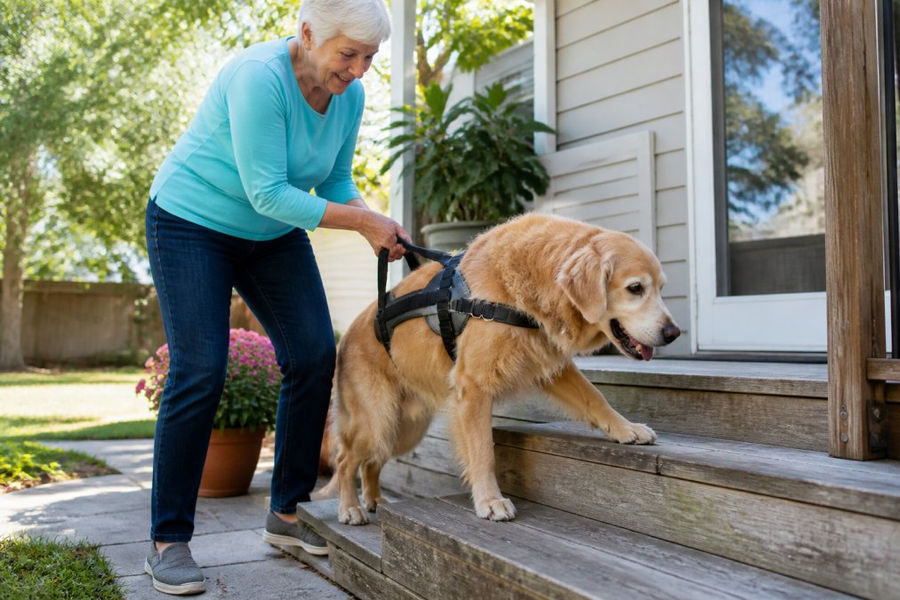
Look for these features:
Padded chest plate that spreads pressure across the sternum, ideally at least 2 inches wide on medium and large dogs
Adjustable girth straps so the harness sits forward of the hip joint, not across it
Dorsal handle positioned between the shoulder blades, not over the lumbar spine
Non-chafing material at the armpits, where friction causes sores
Y-shaped or V-shaped front that keeps the trachea and throat clear
How to Tell If the Harness Is Actually Offloading the Hips
A harness is doing its job when the dog's rear paws land more squarely and the hip sway visible from behind decreases. If the dog still bunny-hops or drags a rear paw, the joint itself is the bottleneck, talk to your veterinarian about pain management and whether a sling or wheelchair becomes appropriate.
Post-Surgical Recovery vs. Chronic Arthritis: Different Support Needs
Post-surgical recovery and chronic arthritis call for different gear, and most guides blur the line. After a TPLO, FHO, or cruciate repair, the dog typically needs a belly sling or rear-lift harness for a few weeks while tissue heals. The goal is controlled, minimal weight-bearing with full support for short trips outside.
A practical way to decide:
Weeks 1-6 after surgery: rear-lift sling or belly support, used only for toileting and short assisted walks
Months 2-6: transition to a full support harness with a handle as weight-bearing increases
Ongoing arthritis management: daily-wear harness with breathable materials and a reinforced handle
Watch Out Do not use a lifting handle to carry a dog's full weight for more than a few seconds. Repeated full lifts strain your back and can torque the dog's spine. Use the handle to steady and guide. If your dog had surgery on one leg, ask your veterinarian whether a sling that supports both rear legs or only the affected side is appropriate. The answer changes the gear you buy. The right harness for hip issues is the one that keeps the chest plate forward of the hip joint and the handle over the shoulders, and that matches the stage of your dog's condition, not just the diagnosis. How to Help a Senior Dog With Back Leg Weakness Helping a senior dog with back leg weakness starts with reducing the load on those legs, not eliminating movement. Total rest accelerates muscle loss. Short, supported walks keep the muscles that stabilize the joints working. A practical routine: Keep walks short and frequent rather than long and occasional Use a harness with a handle to assist on stairs and slick floors Add non-slip rugs on hard flooring Ask your vet about joint supplements and pain management Weigh your dog monthly; extra pounds load the hips directly Integrating Harnesses With Other Mobility Aids A harness works best alongside other aids, not instead of them. Toe grips help with traction on tile. Ramps replace car jumps. Orthopedic beds reduce overnight stiffness. A supportive structure across the day keeps the dog moving more comfortably. The goal is not to stop your dog from moving. It is to make movement easier so the muscles that support the joints stay strong.
Fit, Materials, and Breed-Specific Ergonomic Challenges
Fit matters more than brand. A harness that shifts or rubs causes more harm than a cheaper one that sits correctly. Measure the girth behind the front legs and the chest width, then check the sizing chart. For senior dogs, add a third measurement: sternum to the base of the rib cage, because a chest plate that is too short rides up into the throat when you use the handle.
Breed-Specific Ergonomic Challenges
Most harness guides treat dogs as one shape. They are not, and senior dogs feel the mismatch more because their joints have less tolerance for compensation.
Materials That Hold Up to Daily Senior Use
Material choices matter more for senior dogs because the harness is worn longer and grabbed more often.
Breathable mesh for warm weather and daily wear; look for padded liners at the armpits and sternum
Reflective trim on the chest and back for nighttime visibility
Quick-release buckles for dogs who resist dressing, and for owners with arthritis in their hands
Reinforced stitching at the handle, the first point to fail; box-X stitching is stronger than single-line stitching
Metal D-rings rather than plastic for the leash attachment on large dogs
Adjustment and Break-In
Adjust a new harness before the first walk, not during it. Tighten the girth so you can fit two fingers under the strap, then check the chest panel for gaps. Walk the dog five minutes indoors, then recheck. Most harnesses loosen slightly after the first few wears as the webbing settles.
Pro Tip Wash a new harness once before first use if your dog has sensitive skin. Manufacturing residue and dye transfer are common causes of initial irritation. Breed geometry, not brand, determines whether a harness helps or hurts. Measure girth, chest width, and sternum-to-rib length, then match the harness cut to your dog's shape. Top Ruffwear Alternatives for Senior Dog Support 1. Luv My Pets is our top pick for owners who want premium support gear and a purchase that gives back. This veteran-owned retailer donates 10% of every purchase to fund the training of service and comfort dogs for veterans and first responders. The catalog focuses on health and happiness essentials, and the support team provides expert customer support for pet health and veteran-related inquiries. Owners who want premium senior dog support gear and a purchase that funds service dog training for veterans and first responders.
Frequently Asked Questions
What brands are similar to Ruffwear for senior dog support?
Several brands offer comparable or specialized senior dog support. Hurtta makes weather-resistant harnesses with integrated lift handles and ergonomic weight distribution. Kurgo's Journey Air protects the trachea with a V-neck design and includes a rear handle. OneTigris builds heavy-duty tactical harnesses with vertical control handles for large breeds. For budget-conscious owners, Auroth and Eagloo provide functional lift-assist handles at lower price points. Each option serves different needs, so match the harness to your dog's specific mobility limitations.
What is the best support harness for dogs with hip dysplasia?
The best harness for senior dogs with hip issues distributes weight away from the hip joint and provides rear-end lift. Look for a padded chest plate, adjustable straps around the girth, and a dorsal handle positioned over the shoulders for balanced lifting. Full-body harnesses that wrap under the belly offer more hind-leg support than step-in styles. Breathable mesh lining and non-chafing material matter for dogs wearing the harness for extended periods. A veterinary-recommended fit ensures the harness supports rather than restricts natural movement.
How can I help my older dog whose back legs are collapsing?
Start with a support harness that includes a rear lift strap or belly sling to take weight off the hind legs during walks and stairs. Keep walks short and on non-slip surfaces. Raise food and water bowls to reduce bending. Use rugs or yoga mats on slick floors. Talk to your veterinarian about arthritis management options and whether a canine rehabilitation specialist could help. For severe cases, a full-body evacuation sling provides complete support when your dog can no longer walk independently.
How do I know if my dog needs a full-body support harness?
Signs include difficulty rising from a lying position, hind legs sliding out on smooth floors, reluctance to climb stairs, and visible rear-end weakness after short walks. If your dog can still walk but needs occasional help over obstacles, a harness with a lift-assist handle works well. If your dog can no longer bear weight on the back legs, a full-body support harness or evacuation sling becomes necessary. Watch for changes in gait and ask your vet for a mobility assessment.
Are there budget-friendly alternatives to premium dog harnesses?
Yes. Auroth and Rabbitgoo offer harnesses with padded chest plates and adjustable straps. Coastal Pet's K9 Explorer provides reflective trim and durable hardware. These options cover basic comfort and visibility needs but may lack the reinforced lifting handles found on premium harnesses. If your dog needs frequent lifting assistance, investing in a harness with a sturdy dorsal handle and ergonomic weight distribution is worth the higher cost.
Check out our products here


Comments